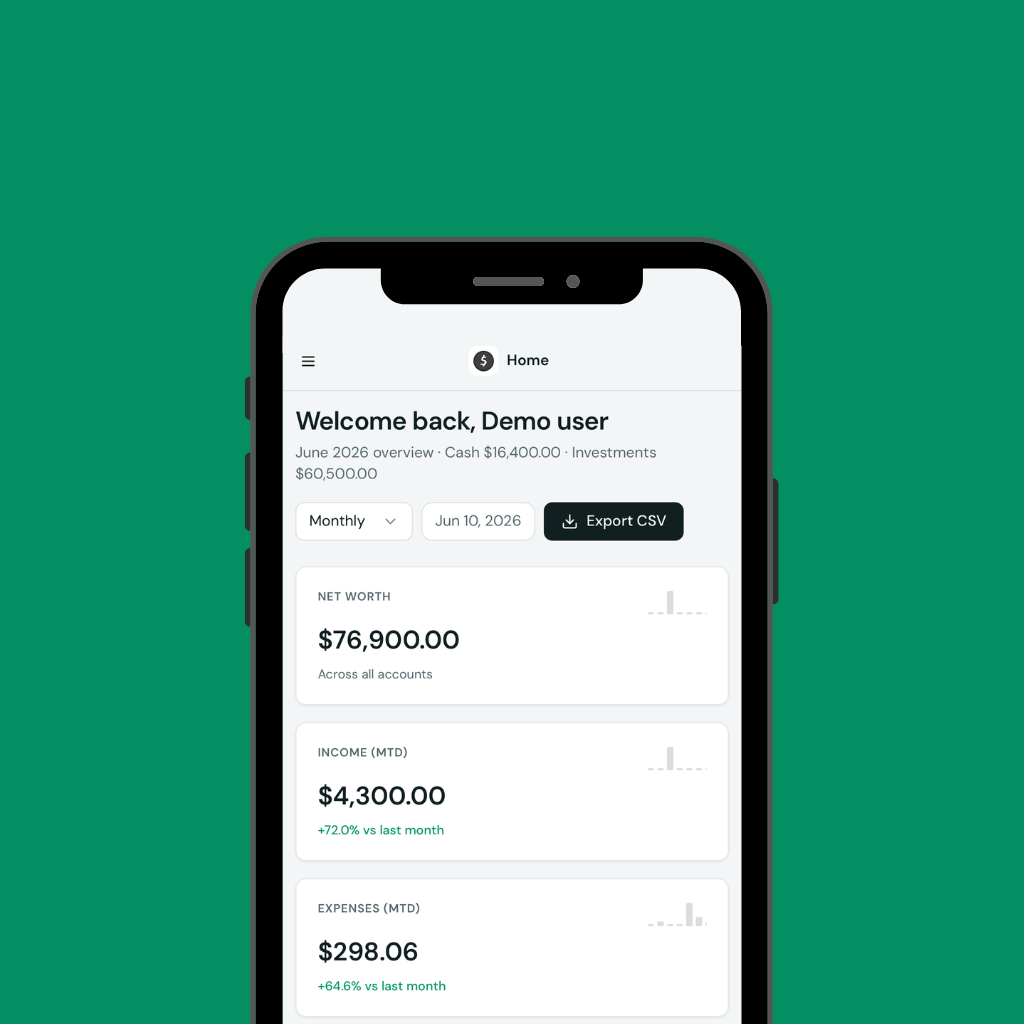
Obol started because I couldn't find a finance tool that handled everything I wanted in one place. Personal expenses, business transactions, receipts, investments, budgets, and tax-related records were spread across multiple apps and spreadsheets. I wanted a system that gave me a complete picture of my finances while also integrating with the other tools I was building. The result was Obol, a finance platform that centralizes financial data and serves as the financial backbone of my broader software ecosystem.
Managing finances often requires jumping between multiple applications for budgeting, banking, investments, receipts, taxes, and business expenses. This fragmentation makes it difficult to maintain accurate records, understand spending habits, and quickly answer questions about financial performance.
Build a centralized financial management platform that provides visibility into personal and business finances while reducing manual tracking and simplifying financial organization.
I developed Obol as a finance-focused platform that aggregates financial information from multiple sources into a single dashboard. The system combines transaction tracking, budgeting tools, receipt management, investment monitoring, and reporting features. To support future integrations, I also developed the Obol API, which allows financial data to be accessed by other applications, including Arlo, enabling cross-platform insights and AI-powered financial analysis.
Challenges
What was hard
- Creating a flexible data structure capable of handling many different types of financial information, including transactions, receipts, budgets, investments, and tax records.
- Normalizing data from multiple sources so it could be analyzed consistently across the platform.
- Building the Obol API added an additional layer of complexity because the data needed to be accessible and usable outside of the application itself.
Wins
What worked
- Personal and business expense tracking
- Transaction logging and categorization
- Receipt storage and management
- Budget planning and monitoring
- Investment tracking and portfolio monitoring
- Tax document organization
- Financial reporting and analytics
- Custom Obol API for external integrations
- Integration with Arlo for cross-platform financial insights
- Searchable financial records and history
- Developed a centralized financial management system that consolidates personal and business financial data into a single platform. The addition of the Obol API transformed the project from a standalone application into a reusable financial data platform capable of powering other tools and workflows.
- Obol significantly improved my understanding of financial systems, data modeling, API design, and software architecture. Building the platform required careful consideration of how financial data is stored, categorized, and queried. Developing the Obol API also reinforced the importance of designing software with interoperability and future integrations in mind.
Skills
What I learned
Impact
Outcomes
- Replaced a collection of disconnected finance tools and spreadsheets with a single source of truth for personal and business finances.
- Created a financial data layer that powers insights and workflows across other applications, including Arlo.